Independent Research Concept

Exploring AI for Critical Subsea Infrastructure Awareness

A research-led exploration of how AI, autonomous maritime systems, and distributed sensing could improve understanding of undersea pipelines, data cables, and strategically significant maritime infrastructure.

1.3M km
Subsea cables globally
500+
Active cable systems
95%
Of internet traffic
Nord Stream Pipeline Sabotage — 2022 Baltic Sea Cable Disruptions — 2024 Red Sea Cable Damage — 2024 Taiwan Strait Cable Incidents — 2023 Arctic Undersea Infrastructure Under Surveillance Svalbard Cable Cut — 2022 Nord Stream Pipeline Sabotage — 2022 Baltic Sea Cable Disruptions — 2024 Red Sea Cable Damage — 2024 Taiwan Strait Cable Incidents — 2023 Arctic Undersea Infrastructure Under Surveillance Svalbard Cable Cut — 2022

Understanding the Arteries of Global Connectivity

Subsea pipelines and data cables form the invisible backbone of the modern world — carrying the energy and information that underpin every economy. Yet they remain difficult to observe, complex to govern, and increasingly exposed to accident, interference, and geopolitical pressure.

Subsea Sentry AI is an independent research concept investigating how autonomous maritime systems, AI-assisted analysis, and distributed sensing might support better awareness, resilience planning, and strategic understanding around subsea infrastructure.

🔍
Persistent Awareness
Researching how longer-duration observation could help characterise routes, environments, and anomalies over time.
Anomaly Analysis
Exploring how AI-assisted pattern recognition could support earlier interpretation of unusual subsea activity.
🛰️
Systems Perspective
Considering how cable, pipeline, power, maritime, and policy datasets can be understood together.
🤝
Public Interest Lens
Reviewing subsea infrastructure resilience as a shared economic, environmental, and security challenge.
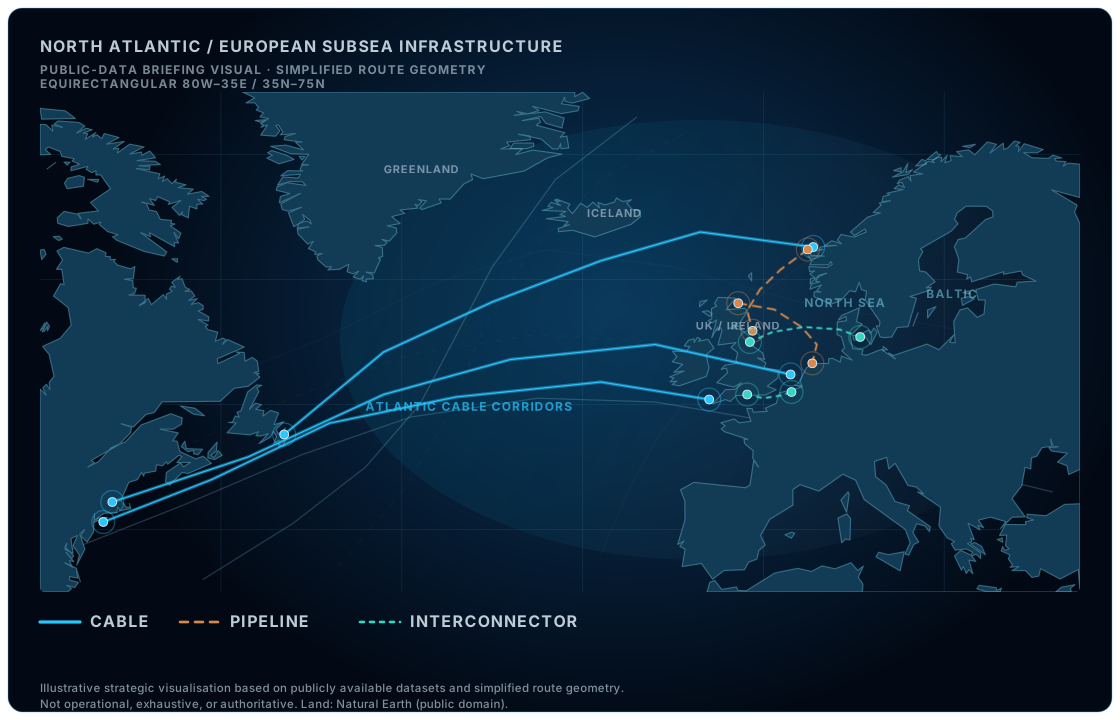
Data Cables Pipelines Research Node Risk Area

Built for the Harshest Environment on Earth

Exploring where AI, autonomous maritime systems, and multi-layer sensing could contribute to better subsea awareness and resilience planning.

🤖

Autonomous Underwater Vehicles

Assessing how AUV capabilities, endurance constraints, navigation limits, and route-planning methods may shape future approaches to subsea infrastructure observation.

🧠

AI-Assisted Pattern Analysis

Researching how multi-modal data from sonar, acoustic, optical, and electromagnetic sources could be interpreted to identify patterns, anomalies, and changes in subsea environments.

📡

Subsea Communications

Reviewing acoustic, optical, and surface relay communication methods, including the practical limits they impose on latency, bandwidth, and situational understanding.

🔬

Multi-Modal Sensor Array

Considering how synthetic aperture sonar, hydrophone arrays, chemical sensing, and optical imagery could complement one another in research datasets and analytical models.

☁️

Analytical Platforms

Exploring how historical incident data, infrastructure maps, sensor outputs, and environmental context could be organised for research, analysis, and responsible commentary.

⚙️

Endurance & Support Concepts

Researching energy, maintenance, docking, data offload, and recovery concepts that may affect whether persistent subsea awareness is practical in demanding maritime environments.

Systems Worth Understanding

These systems underpin modern connectivity, energy, and resilience, making them important subjects for independent analysis.

🌐

Subsea Internet Cables

Over 1.3 million km of fibre optic cables carry 95% of all intercontinental internet traffic and financial data. A targeted cut can isolate entire continents and trigger cascading economic disruption.

Critical National Infrastructure
🛢️

Energy Pipelines

Thousands of kilometres of natural gas and oil pipelines traverse contested seabed. As demonstrated by Nord Stream, their disruption can destabilise energy markets and drive geopolitical crises.

Strategic Energy Security

Offshore Power Interconnects

High-voltage direct-current cables connecting national power grids enable renewable energy sharing. Damage disables grid balancing and creates electricity shortfalls across multiple countries.

Grid Resilience
🏭

Offshore Energy Platforms

Oil and gas platforms, wind-farm foundations, and their subsea export infrastructure represent complex maritime systems where underwater disruption can create economic and environmental consequences.

Economic & Environmental Risk

From Concept to Strategic Understanding

A staged research path moving from open-source landscape analysis toward clearer questions about technology, governance, resilience, and maritime risk.

Phase 1 — Current

Threat Landscape Review & Research Questions

Reviewing known subsea infrastructure incidents, emerging risk patterns, existing detection gaps, and the technical questions that shape responsible research in this area.

Phase 2

Sensor Fusion & AI Feasibility

Assessing how synthetic and publicly available acoustic, sonar, and optical datasets might support research into anomaly detection, uncertainty, and false-positive risk.

Phase 3

Autonomous Maritime Systems Assessment

Reviewing the capabilities and limits of AUVs, surface relays, docking concepts, communications, and autonomy in relation to subsea awareness research.

Phase 4

Strategic Understanding & Commentary

Developing analysis that helps explain resilience options, policy tradeoffs, technology gaps, and the practical limits of AI-enabled subsea awareness.

Open to Relevant Conversations

Subsea Sentry AI is open to thoughtful conversations with researchers, analysts, infrastructure operators, policy specialists, journalists, and domain holders interested in subsea awareness and resilience.

✉️
General Enquiries
hello@subseasentry.ai
💼
Research & Analysis
research@subseasentry.ai
🤝
Domain & Brand Enquiries
brand@subseasentry.ai